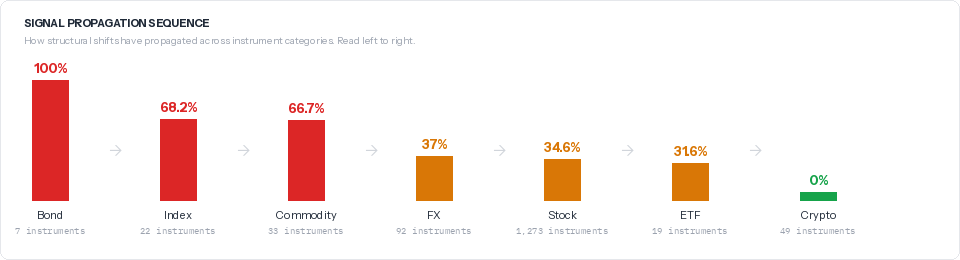
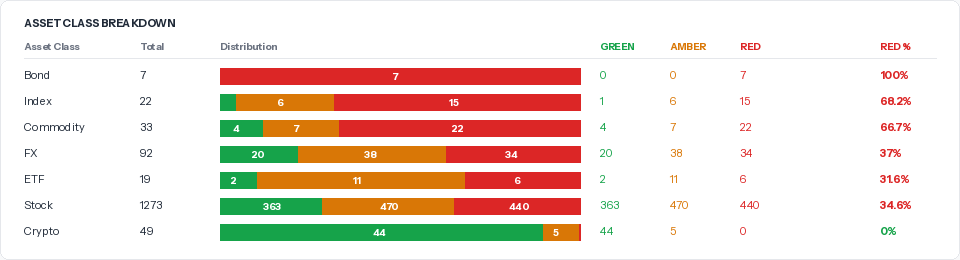
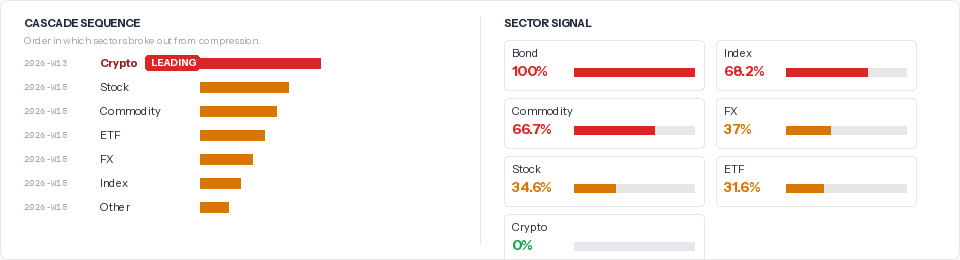
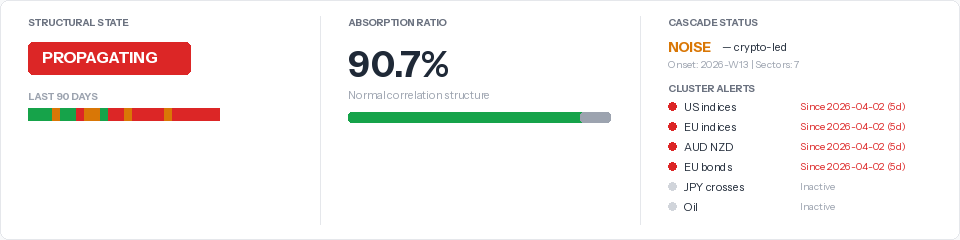
The Antecedent Engine does not predict direction. It detects when the structural state of a system is changing — before the change becomes visible to conventional indicators. The architecture is direction-agnostic: a Propagating reading does not indicate whether markets move up or down, only that a confirmed signal is spreading across correlated systems.
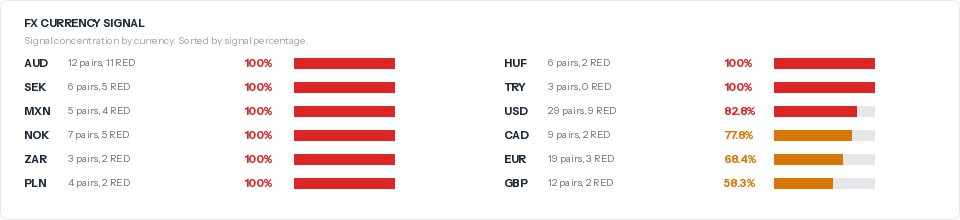
Currently deployed across approximately 1,500 instruments spanning FX, equities, indices, commodities, bonds, crypto, and ETFs. Outputs include per-instrument state classification, cluster warnings, cascade detection, and contagion mapping.
Engine v2.3 — ~1,495 instruments — Institutional access only. Not investment advice.
Most recent confirmed transition: structural tension detected 22 days before the Iran conflict escalation, April 2026. Cluster warnings, cascade sequence, and contagion mapping delivered to subscribers before conventional indicators responded.
Once a state is recorded, it does not change retroactively. The same input always produces the same output. The engine detects the weather. You decide whether to carry an umbrella.
The underlying detection architecture is domain-agnostic. Financial markets is the first deployment. If your industry requires structural state classification, get in touch.
For nearly a century, displacement predictions have consistently overestimated the labour market consequences of automation. Seven original contributions including the Measurement Obsolescence Hypothesis, Organisational Absorption Rate, and Economic Forcing Function.
The US is identified as a global outlier rather than the representative case that displacement predictions assume. GA/GD independence confirmed in eight of ten economies. Financial sector “AI displacement” systematically misattributed in all ten countries examined.
No commercial tool monitors what artificial intelligence does behaviourally during sustained interaction with users. Evidence from 76,514 AI messages across 226 sessions and 3,226 aggregate hours of naturalistic production interaction. Eleven behavioural failure patterns named and quantified.
Existing AI governance infrastructure tracks per-response quality metrics but does not measure behavioural patterns that emerge across sessions: whether the AI maintains its own corrections, whether its expressed confidence predicts accuracy, whether its private reasoning matches its public output.
Multiple government bodies have independently identified this gap. Our research presents the evidence and names the failure patterns. The detection methodology exists. The framework is designed for enterprise and government AI deployment.
The highest-capability frontier model with safety guardrails produces documented behavioural failure rates across sustained interaction. Existing deployment monitoring does not detect these patterns. Our framework addresses the gap between per-response quality metrics and cross-session behavioural reliability, protecting the user and minimising performance degradation across sustained AI deployment.
Enterprise deployment enquiries →Automated multi-asset signal detection spanning FX, indices, metals, and energy. Signal infrastructure supports daily market reports and weekly outlooks for broker clients.